|
|
|
|
|
"Don't Ask, Don't Tell" Revisited | |
|
|
||
|
Under federal law, openly gay people are prohibited from serving in the US military.
This is often referred to as the Don't Ask, Don't Tell policy.
|
||
|
See Dr. Herek's blog
for updates on "Don't Ask, Don't Tell" |
The Pentagon's principal justification for the policy continues to be that the presence of openly gay and lesbian personnel
would interfere with the military's ability to accomplish its mission.
In essence, the Pentagon's rationale is that heterosexual personnel have such antipathy for
gay people that they would be unable and unwilling to serve with them.
Moreover, the Department of Defense believes that it is powerless to prevent this hostility
from interfering with the military mission.
Thus, the presumed focus of the problem is not really homosexual personnel.
Rather, it is heterosexual servicemembers and military leadership.
|
|
|
Scientific research and policy studies indicate that the Pentagon is wrong.
Heterosexuals' hostility toward homosexuality need not interfere with the military mission,
provided that strong leadership is exercised and clear rules are enforced concerning nondiscrimination.
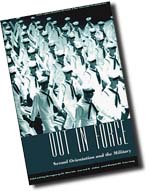
The links on this page summarize findings relevant to the military policy that Dr. Herek has compiled from his own empirical research and that of other scientists for Congress, the courts, and the public. A more extensive review of the data is available in a 2005 chapter by Prof. Herek and Prof. Aaron Belkin, Sexual Orientation and Military Service: Prospects for Organizational and Individual Change in the United States, and in Out In Force: Sexual Orientation and the Military, edited by Prof. Herek, Jared B. Jobe, & Ralph M. Carney. |
|
|
|
|
|
|
|
|
|||
|
|
Information about the 2005 chapter coauthored by Professor Herek and Professor Aaron Belkin,
Sexual Orientation and Military Service: Prospects for Organizational and Individual Change in the United States.
|
||
|
|
Read a brief history of the military's policies toward homosexuals and racial minority groups.
|
||
|
|
A comparison of race and sexual orientation relevant to the military policy.
|
||
|
|
Terms and concepts relevant to the military policy.
|
||
|
|
Unit cohesion and the military mission.
|
||
|
|
Read Dr. Herek's op-ed piece on the "Don't Ask" policy in the San Francisco Chronicle (March 6, 2000).
|
||
|
|
Read Dr. Herek's 1993 congressional testimony on behalf of the APA and other professional organizations.
|
||
|
|
Read Dr. Herek's 1995 expert
declaration in the Able vs. Perry case.
|
||
|
|
An extensive review of scientific data relevant to the military policy is available in Out In Force: Sexual Orientation and the Military, edited by Gregory M. Herek, Jared B. Jobe, & Ralph M. Carney. |
||
|
|
Here are some recent postings on Beyond Homophobia, Dr. Herek's Blog:
|
||
|
Resources From
Other Sites |
|
The Michael D. Palm Center and the
Center for the Study of Sexual Minorities in the Military (CSSMM) at UC Santa Barbara.
|
|
|
|
Gay Men and Lesbians in the U.S. Military: Estimates from Census 2000, a 2004 report by Gary Gates from the nonpartisan Urban Institute.
|
||
|
|
Don't Ask, Don't Tell, Don't Pursue Database, a project of the Robert Crown Law Library at Stanford Law School.
|
||
|
|
Sexual Orientation and U.S. Military Personnel Policy: Policy Options and Assessment, by the National Defense Research Institute (the 1993 RAND report).
|
||
|
|
Relevant papers by Prof. Robert MacCoun, a noted authority on the military policy and a contributor to the 1993 RAND report.
|
||
|
|
Get the latest report on
implementation of the "Don't Ask, Don't Tell" policy from the Servicemembers Legal Defense Network.
|
||
|
|
|
Home
|
Hate Crimes
|
AIDS
|
Sacramento
|
The Facts
|
Military
|
Sexual Prejudice
|
|
Blog | Blog | Contents | Publications | Library | Web Search | Contact Us | Useful Links | Social Psych Net |
|
|
||
|
All original content of this website is copyright © 1997-2008 by Gregory M. Herek, Ph.D.
All rights reserved |